
Table of contents
BlogPublished May 20, 2026 · 22 min read
Last updated:
How to Roll Options: When to Roll for Credit, Close, or Let Expire

How to roll options: roll out, roll down, roll for credit vs. debit, five decision rules, and how to journal rolls so you learn instead of chase premium.
Rolling options closes one position and opens another, often the same type and side, new strike or expiration. It feels like progress when premium credits hit the screen; it can also hide growing risk.
Retail sellers roll puts after dips, calls after rips, and both when expiration is too close for comfort. Without a rule, rolls become an expensive habit of postponing decisions.
This guide explains how to roll options: common roll types, credit vs. debit, five rules before you click, and what to log so your journal tells the truth.
You will learn roll out, roll down/up, roll for credit, when to close or expire instead, and links to assignment and put-selling discipline.
What does rolling an option mean?
To roll, you buy back (or sell) your existing option and open a new one, typically same short put or short call, different expiration and/or strike. Brokers often offer a single combo order labeled roll for credit or roll for debit.
Common roll types for sellers:
- Roll out: same strike, later expiration (more time)
- Roll down (puts): lower strike, often more credit or less risk
- Roll up (calls): higher strike on covered calls
- Roll out and down/up: change both time and strike
The CBOE and your broker’s order guide define combo mechanics; economics are still your obligation.
Roll for credit vs. roll for debit
Roll for credit means the net of closing and opening pays you premium. Roll for debit costs cash. Credit rolls feel good short term but can extend exposure in a name you should exit.
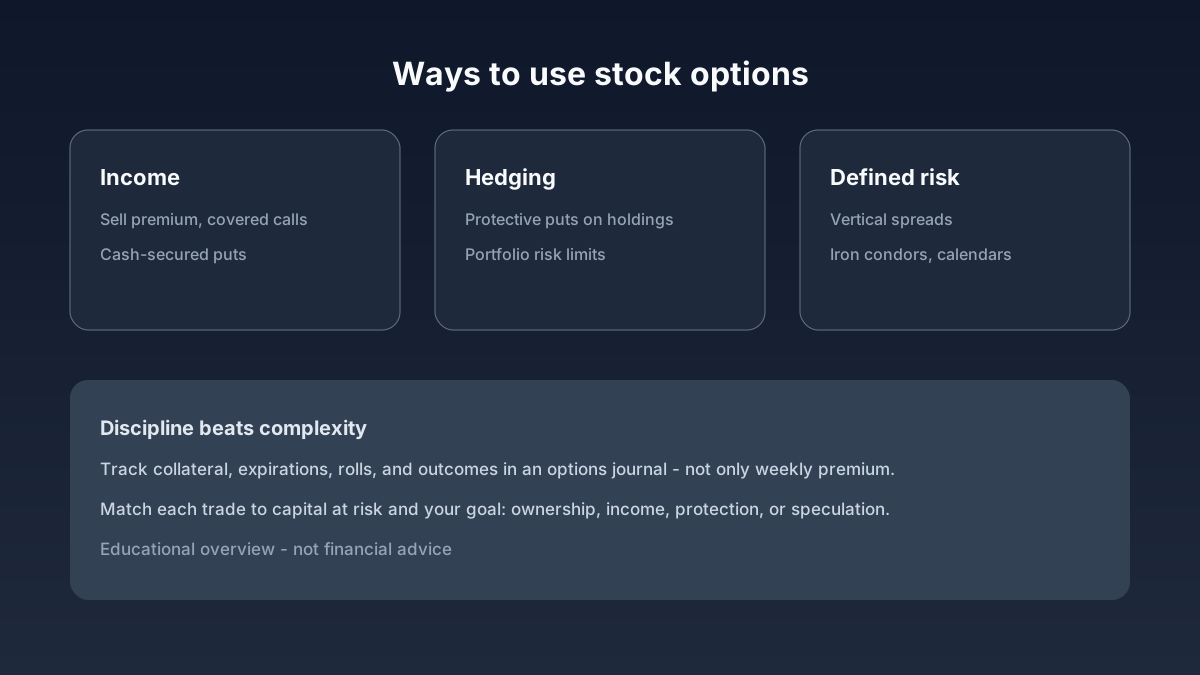
Credit roll: often used when:
- You still want the trade thesis and need more time
- Collateral allows the new line
- You are reducing strike risk (e.g. put roll down) with a plan
Debit roll or close: often better when:
- Thesis broke; you would not open this trade fresh today
- Collateral is maxed; rolling stacks more on one ticker
- You are rolling only to avoid realizing loss without a stock view
A roll in actual numbers
Rolling stays abstract until you price one. Here is the situation almost every put seller meets: you sold a 45 DTE $50 put for $1.20, collecting $120. The stock has slid to $46, there are 10 days left, and the option now costs $4.30 to buy back.
The uncomfortable fact first: you are currently down $310 on that leg, whatever you do next. Rolling does not undo it. It only decides what you hold afterwards.
| Choice | Cash today | Premium collected to date | What you now own | Effective basis if assigned |
|---|---|---|---|---|
| Close it | -$430 | $120 | Nothing, loss realised at $310 | n/a |
| Do nothing, let it run | $0 | $120 | The same put, 10 days of gamma | $48.80 |
| Roll out, same $50 strike, 45 DTE | +$50 credit | $170 | A $50 put, 45 days out | $48.30 |
| Roll down and out to $48, 45 DTE | -$140 debit | $410 | A $48 put, 45 days out | $43.90 |
| Take assignment | -$5,000 | $120 | 100 shares | $48.80 |
Read the last two columns together, because they contain the whole lesson. The roll down and out costs you $140 in cash today, which feels like the worst option on the list. It is also the only one that moves your effective basis from $48.80 to $43.90, meaning the stock can fall almost another 10% before you are underwater on the cycle.
The credit roll, by contrast, pays you $50 and changes almost nothing about your risk: same strike, same obligation, just 45 more days of it. That is the trap in "always roll for credit" advice. A credit tells you the market paid you for time, not that you improved the position (defensive adjustments when short puts go ITM).
What the table does not show, and you should check before clicking:
- Collateral: the $48 put still pledges $4,800, so the position is not smaller, only further away
- Earnings inside the new 45-day window, which would change the calculation entirely
- Whether you would open a fresh $48 put on this stock today at $2.90
- How many times you have already rolled this ticker this quarter
That third bullet is the single best filter anyone has written for rolling. If the answer is no, you are not managing a position, you are avoiding a decision (trading psychology for option sellers).
When rolling quietly becomes the problem
Rolling is a legitimate tool that turns into a bad habit through a very specific mechanism, and it is worth naming because it does not feel like a mistake while it happens.
Each individual roll is defensible. You collect a credit, you push the strike a little further away, the position survives another cycle. Repeat that four times on the same ticker and you are holding a large, long-dated obligation in a name whose thesis you stopped examining months ago, funded by premium you have already spent. The book looks calm. The concentration is not.
Warning signs worth setting a rule against:
- The same underlying rolled three or more times in a quarter
- Total contracts on one ticker growing with each roll
- Expirations pushed steadily further out to keep collecting a credit
- A roll placed within minutes of seeing the position go red
- Not knowing your cumulative premium on the cycle without opening a spreadsheet
A written cap solves this better than judgement does: many sellers limit rolls per ticker per cycle and force a close or an assignment once the cap is hit. The cumulative-premium figure in the last bullet is also the number that tells you whether the whole chain was worth it, which is why roll chains have to stay linked as one position rather than scattering into separate trades (the monthly options review, position sizing and max collateral).
5 rules before you roll
Five rules before rolling:
- Write one sentence: goal of this roll (time, risk, or exit)
- If I would not open the new option today, do not roll: close or assign
- Check total collateral after roll, not only net credit
- Compare roll to taking assignment or closing stock
- Log old and new legs before placing the order
Put sellers: see rolls section in selling puts discipline. Assignment path: options assignment explained.
When to let expire or close instead of roll
Let expire worthless when:
- Option is far OTM and fees matter more than tiny risk
- You have no reason to keep capital pledged on that line
Close (buy back) instead of roll when:
- Remaining premium is small vs. gap risk into expiration
- You want to free collateral for a better setup elsewhere
- Earnings or macro event makes holding the short leg reckless
How to journal a roll
Fields worth logging on every roll:
- Date and reason (one line)
- Closed leg: strike, expiry, buyback price
- Opened leg: strike, expiry, credit/debit
- Net P/L on the roll and running P/L on the ticker cycle
- Updated collateral and next expiration on your calendar
Options trading journal guide and Option Journal help keep rolls visible across expirations.
Conclusion: roll with intent, not with hope
Knowing how to roll options is useful only when you know when not to. The best roll is often the one you skip because assignment or a flat close matches your plan.
Educational only, not personal financial advice. Browse the blog for wheel and expiration guides.
Frequently asked questions
- What does it mean to roll an option?
Rolling closes your current option leg and opens a new one, often different strike or expiration, usually as one linked transaction. You may collect or pay net credit/debit on the roll.
- When should I roll for credit vs. pay debit?
Roll for credit when you still want exposure and the market pays you to extend time or adjust strike. Pay debit when reducing risk is worth the cost: cheaper than holding a bad line into expiration.
- When should I let an option expire instead of rolling?
Let expire when the option is worthless or nearly worthless and closing would cost more in commissions than you save. Also when your thesis is done and you want zero remaining obligation.
- How do I journal a roll?
Record closed leg, new leg, net credit/debit, new strike and expiration, and whether the roll reduced risk or only delayed loss. Link the new line to the original trade IDjournal guide.
- Is rolling the same as avoiding a loss?
Not always. Rolling can be rational risk management, or doubling down. If you would not open the new position fresh today, closing or taking assignment may be cleaner.
- Should I always roll for a credit?
No, and the rule causes real damage. On a $50 put with the stock at $46, rolling out at the same strike might pay a $50 credit while leaving your obligation identical, whereas rolling down to $48 costs $140 and moves your effective basis from $48.80 to $43.90. The credit measures what the market paid you for time, not whether the position improved.
- How many times can I roll the same position?
There is no mechanical limit, which is exactly the problem. Each roll is individually defensible while four in a row leave you with a large long-dated obligation in a name you stopped examining. Many sellers set a written cap per ticker per cycle and force a close or an assignment once it is reached.
From blog to product
Request access to the private beta and we will email you after review.
Request accessRelated articles

How to Run a Monthly Options Trading Review
Key takeaway: A repeatable monthly review for option sellers: which numbers to pull, the metrics that actually matter, how to break results down by ticker and strategy, and the questions to answer each month.
Read more
Trading Psychology for Option Sellers: The Biases That Cost You
Key takeaway: Trading psychology for premium sellers: why a 90% win rate distorts judgement, the traps of revenge trading and sunk cost, discipline in drawdown, and rules that survive stress.
Read more
Covered Call ETFs vs. Selling Your Own Calls
Key takeaway: Covered call ETFs versus selling your own covered calls: how the funds work, what the fees and capped upside really cost, tax and control differences, and who each option actually suits.
Read more