
Table of contents
BlogPublished May 16, 2026 · 24 min read
Last updated:
What Are Options and How Can You Take Advantage of Them?

What are options? Learn how stock options work, the difference between calls and puts, and seven practical ways to use options for income, hedging, and defined-risk trading.
Most beginners hear that options are dangerous, and that is only half the story. Used without rules, leverage and assignment can drain an account fast.
Yet millions of investors use stock options every day for income, hedging, and tactical trades. The gap is rarely talent; it is education, position sizing, and a process you can repeat.
This guide answers the exact question in the title: what options are, how calls and puts work, and how you can take advantage of options responsibly, with lists, visuals, and links to trusted regulators and educators.
In this article you will learn: what a stock option is, how to compare calls and puts, seven ways to use options in a real portfolio, and a five-step checklist to get started, without drowning in jargon.
What are options?
A stock option is a financial contract that gives the buyer the right, but not the obligation, to buy or sell shares of an underlying asset (usually a stock or ETF) at a fixed strike price before or on an expiration date. Sellers receive premium upfront and take on the obligation if the buyer exercises.
In the United States, one listed equity option typically represents 100 shares. The Options Clearing Corporation (OCC) explains clearing, exercise, and assignment: the plumbing that keeps the market functioning.
Core building blocks of every options trade:
- Underlying: the stock, ETF, or index the contract references
- Strike price: the price at which shares may be bought (call) or sold (put)
- Expiration: the last day the contract exists (American options may be exercised earlier)
- Premium: the market price of the option, driven by time value and implied volatility
Because options are derivatives, their value moves with the underlying, time decay, and volatility. That is why the SEC's investor guide to options stresses understanding risk before you trade, not after your first assignment.
Calls vs. puts: the two types of options
Every options strategy combines calls, puts, or both. The CBOE's education hub is a solid reference for how listed contracts behave in live markets.
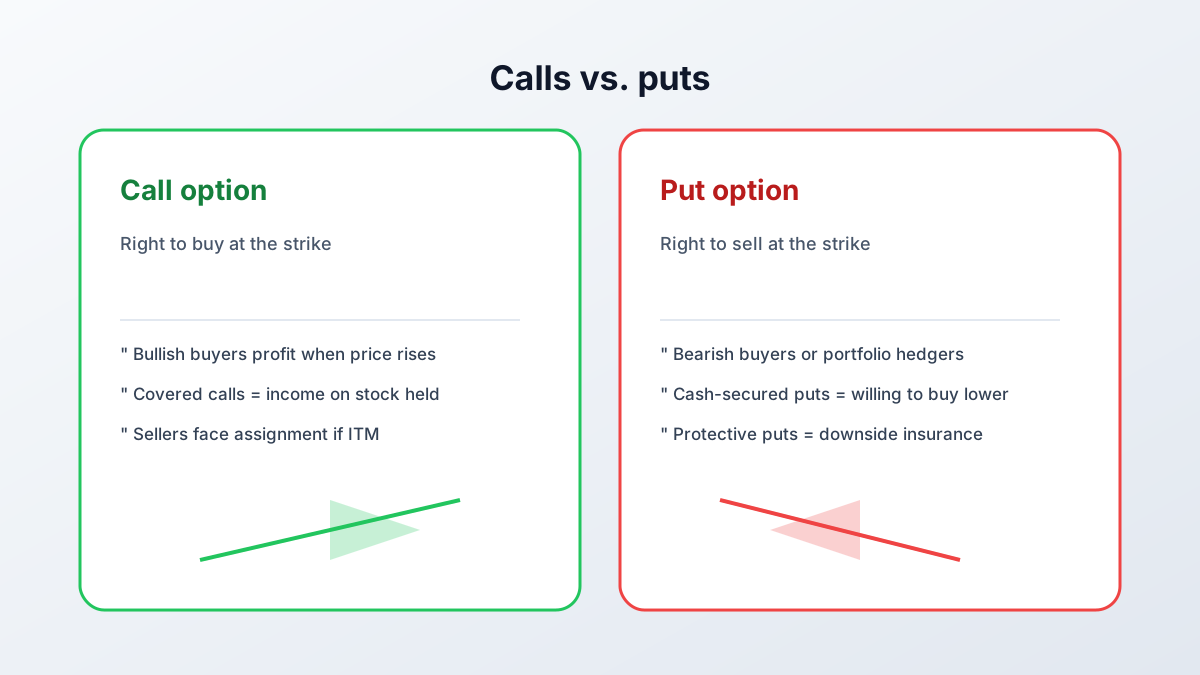
| Call option | Put option | |
|---|---|---|
| Buyer right | Buy at strike | Sell at strike |
| Buyer profits when | Stock rises | Stock falls |
| Seller obligation | Deliver shares | Buy shares |
| Seller profits when | Option expires OTM | Option expires OTM |
| Common seller strategy | Covered call | Cash-secured put |
| Max buyer loss | Premium paid | Premium paid |
Call options: right to buy:
- Buyers pay premium for upside exposure with loss limited to that premium
- Sellers (writers) may be assigned to deliver shares if the call finishes in the money
- Covered calls pair long stock with a short call for income
Put options: right to sell:
- Buyers gain when the underlying falls or use puts as portfolio insurance
- Sellers may be assigned to buy stock at the strike (cash-secured puts)
- Protective puts hedge stock you already own
For every buyer there is a seller. Taking advantage of options starts with knowing which side of the trade you are on, and what can go wrong if the market gaps against you.
7 essential options terms for beginners
Search engines and trading platforms assume you know this vocabulary. The FINRA options overview is worth bookmarking while you learn.
Seven terms you will see on every options chain:
- Premium: the price per share you pay (buyer) or receive (seller) for the contract. Multiply by 100 for one standard equity contract's dollar amount. Premium blends intrinsic value (if ITM) and extrinsic value (time + volatility).
- In the money (ITM): the strike is favorable versus the current stock price: calls with strike below spot, puts with strike above spot. ITM options have intrinsic value and usually cost more than OTM contracts with the same expiration.
- Out of the money (OTM): no intrinsic value; the option would not be exercised if expiration were today. OTM options are cheaper but need a larger move to profit. Many premium sellers open OTM to collect time decay.
- Implied volatility (IV): the market's consensus forecast of how much the underlying might move, reverse-engineered from option prices. When IV is high, premiums are expensive, good for sellers opening new positions, costly for buyers. IV spikes around earnings, Fed announcements, and major news, then often drops after the event (IV crush).
- Time decay (theta): the daily erosion of extrinsic value as expiration approaches. Short options usually benefit from theta; long options fight it. Theta accelerates in the final weeks before expiration, which is why many sellers target 30–45 DTE entries.
- Open interest: the number of outstanding contracts that have not been closed. Higher open interest often means tighter bid-ask spreads and easier fills. It is a liquidity signal, not a directional forecast.
- Assignment: when an option seller must fulfill the contract: deliver shares on a short call or buy shares on a short put. American-style equity options can be assigned before expiration. Sellers should plan for assignment before they collect premium, not after a gap down.
7 practical ways to take advantage of options
“Taking advantage” does not mean chasing lottery tickets. It means matching a defined goal, income, ownership, protection, or speculation, to a structure you understand.
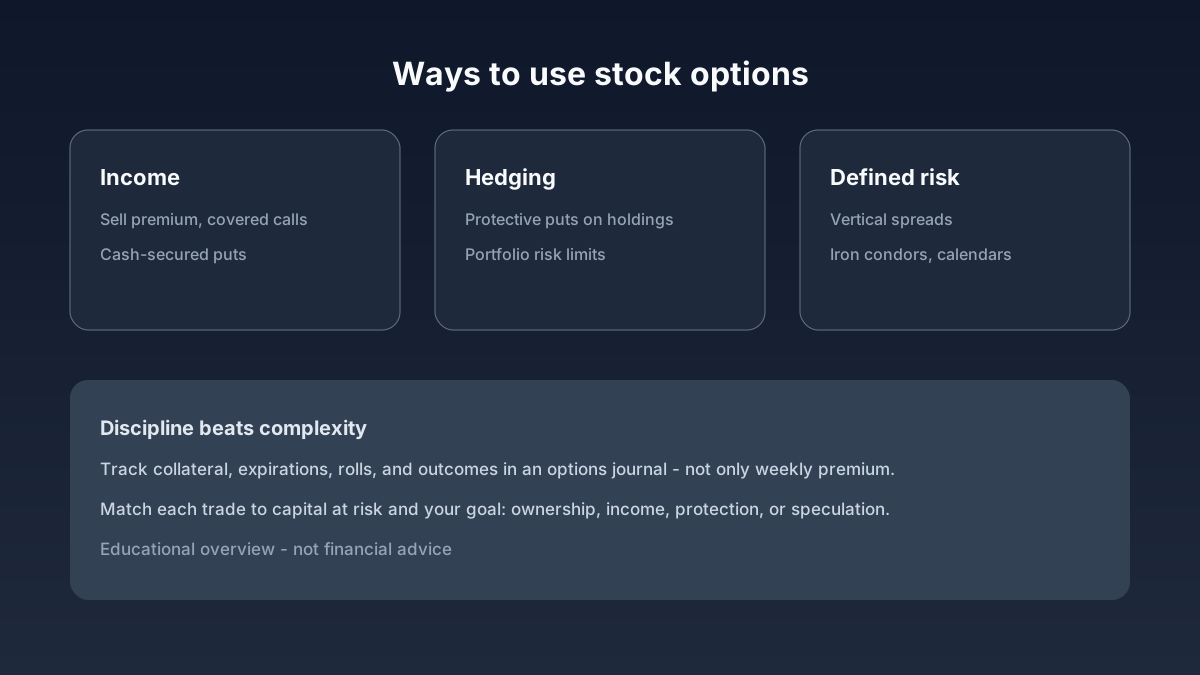
Seven common approaches (with different risk profiles):
- Sell cash-secured puts on stocks you want to own at a lower effective entry (strike minus premium). Example: AAPL at $200, sell the $190 put for $3.00. You collect $300 per contract and may buy 100 shares at $190 if assigned, effective cost $187 per share.
- Write covered calls against shares you hold when you are willing to sell at the strike. Example: you own 100 shares at $180, sell the $195 call for $2.50. You keep $250 premium; if called away above $195, you sell at an effective $197.50.
- Buy protective puts to cap drawdowns on a concentrated position. Example: 200 shares at $150, buy one $140 put for $4.00 ($400). Below $140, the put gains value and offsets stock losses, portfolio insurance with a known upfront cost.
- Use vertical spreads to trade direction with a known max loss. Example: bullish debit call spread, buy $100 call, sell $105 call for a net $2.00 debit ($200). Max profit $300 if stock finishes above $105 at expiration; max loss is the debit paid.
- Sell iron condors in range-bound, high-IV environments (advanced). Example: collect $1.50 credit on a $10-wide SPY iron condor ($150 max risk per spread unit). Profit if SPY stays between short strikes through expiration, requires strict size limits and exit rules.
- Buy long calls or puts for tactical bets with premium as the stop. Example: buy a $50 put for $2.00 ($200) ahead of a known event. If wrong, loss is capped at $200; if the stock drops sharply, the put can multiply in value.
- Roll positions, close and reopen, to manage expirations instead of hoping for miracles. Example: short $45 put expiring Friday is ITM; roll to next month $43 put for a $0.80 net credit. Document whether the roll reduced risk or only bought time.
If your focus is premium and collateral, read our follow-up on selling puts and capital at risk and why weekly P&L tells an incomplete story.
Risks you must understand before selling options
Selling options can feel effortless in calm markets. The SEC and FINRA both warn that short options can involve substantial risk, including assignment on sharp moves.
Risks that catch disciplined investors off guard:
- Gap risk: overnight moves bypass intraday stop logic
- Assignment on short puts: buying a falling stock at the strike
- Uncovered calls: theoretically unlimited loss if the stock soars
- Correlation: many short puts in the same sector move together in a crash
- Overconfidence after a streak of small wins: tail events still happen
That is why serious option sellers track collateral, expirations, and rolls in a dedicated options trading journal, not a spreadsheet you update once a month.
How to get started: 5 steps (how-to checklist)
Treat this as a tutorial, not a race. Brokers publish margin and risk disclosures; read them before your first short option.
Five steps to start learning options the right way:
- Read regulator primers (SEC, OCC) and paper-trade in a simulator
- Pick one strategy, e.g. cash-secured puts or covered calls, and master its payoff diagram
- Size positions so one bad week does not force emotional decisions
- Log every trade: strike, expiration, premium, collateral, and outcome
- Review monthly; iterate rules instead of chasing the next headline ticker
When your first trades start multiplying, puts, covered calls, rolls, assignments, a spreadsheet stops working.
Option Journal tracks your strikes, collateral, and expirations in one view, built for premium sellers from day one.
Request accessConclusion: education first, edge second
Stock options are contracts on an underlying, priced by premium, bounded by expiration, and shaped by volatility. You take advantage of them by choosing a role, buyer or seller, that fits your goal and by respecting assignment and capital limits.
Key takeaways:
- Options are rights (buyers) and obligations (sellers): know which side you trade
- Calls and puts are the atoms of every strategy; combine them for defined risk
- Income, hedging, and speculation all work, but only with sizing and records
- Use authoritative sources (SEC, OCC, CBOE, FINRA) before copying social-media trades
This article is educational, not personal financial advice. Markets change; your process should too. Start small, document everything, and let compound discipline, not hype, drive your options journey.
Frequently asked questions
- What is the difference between a call and a put option?
A call gives the buyer the right to buy shares at the strike; a put gives the right to sell at the strike. Call buyers profit when the stock rises; put buyers when it falls. Sellers of either side collect premium and accept assignment obligations if the option finishes in the money. See the comparison table above for a side-by-side summary.
- Can you lose more than you invest with options?
Buyers can only lose the premium paid: loss is capped at entry. Sellers face larger risks: a short put can force you to buy stock at the strike, and an uncovered call has theoretically unlimited loss if the stock surges. Defined-risk structures like vertical spreads cap maximum loss on both legs.
- What happens when an option expires worthless?
If an option expires out of the money, it expires worthless. The buyer loses the premium paid; the seller keeps the full premium as profit on that contract. No shares change hands and no further obligation exists after expiration.
- How much money do you need to start trading options?
Brokers require options approval and often a minimum balance. For cash-secured puts, reserve strike × 100 per contract: a $30 strike needs $3,000 per contract. Covered calls require 100 shares per contract. Start with paper trading, then one small live position. Confirm margin and buying-power rules with your broker before sizing.
- What is the best options strategy for beginners?
Covered calls and cash-secured puts are the most common starting points: defined mechanics, no naked unlimited risk, and typically available at lower approval tiers. Master one strategy's payoff diagram before adding spreads or condors. Our guides on selling puts and covered calls go deeper.
- Are options riskier than stocks?
It depends on how you use them. Buying options limits loss to premium, which can be smaller than owning stock outright. Selling uncovered options can exceed stock risk. Covered calls and cash-secured puts often behave like stock ownership with a small premium buffer, not a free pass to ignore drawdowns.
- What does it mean to sell an option?
Selling (writing) an option means you collect premium upfront and accept an obligation: buy stock on a short put or deliver stock on a short call if the buyer exercises. Sellers profit when the option expires worthless or when they buy it back for less than they sold it. Premium sellers should track collateral and assignment risk from day one.
From blog to product
Request access to the private beta and we will email you after review.
Request accessRelated articles
How to Run a Monthly Options Trading Review
Key takeaway: A repeatable monthly review for option sellers: which numbers to pull, the metrics that actually matter, how to break results down by ticker and strategy, and the questions to answer each month.
Read more
Trading Psychology for Option Sellers: The Biases That Cost You
Key takeaway: Trading psychology for premium sellers: why a 90% win rate distorts judgement, the traps of revenge trading and sunk cost, discipline in drawdown, and rules that survive stress.
Read more
Covered Call ETFs vs. Selling Your Own Calls
Key takeaway: Covered call ETFs versus selling your own covered calls: how the funds work, what the fees and capped upside really cost, tax and control differences, and who each option actually suits.
Read more