
Table of contents
BlogPublished June 18, 2026 · 22 min read
Last updated:
Iron Condors Explained: Defined-Risk Premium Selling for Range-Bound Markets
Iron condors explained: how the four-leg defined-risk structure collects premium, how to set strikes and width, plus a worked example, management, and seven rules.
An iron condor is the defined-risk way to sell premium when you expect a stock or index to stay in a range. It pairs a put credit spread below price with a call credit spread above it.
You collect two credits up front. Both wings cap your loss, so the trade never carries the open-ended risk of a naked strangle, at the cost of a lower credit and a profit ceiling.
This guide breaks down iron condor mechanics, a fully worked example on a $100 stock, strike and width selection, the trade-offs versus single spreads and strangles, how to manage and adjust the position, when to stay out, seven pre-trade rules, and the fields to log so each four-leg trade stays readable in your journal.
You will learn what an iron condor is, how it differs from a short strangle and a single credit spread, how to size and manage the four legs, and when the trade is not worth putting on.
What is an iron condor?
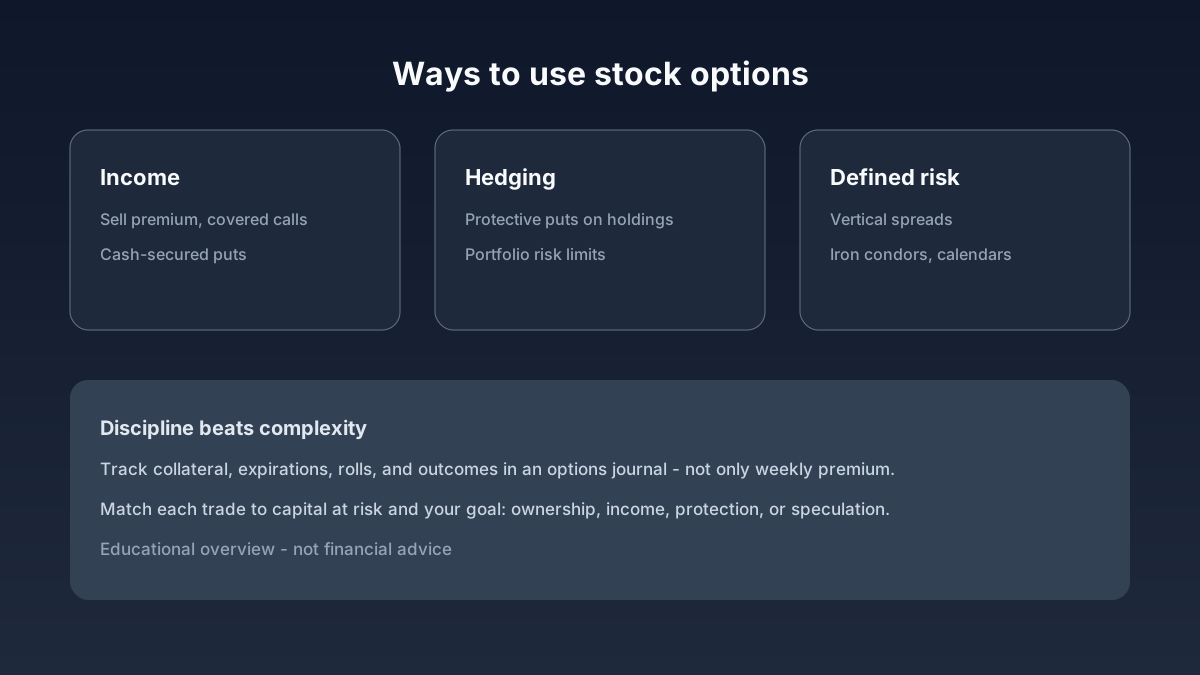
An iron condor combines two vertical credit spreads on the same expiration: a put credit spread below the current price and a call credit spread above it. You sell the inner strikes (closer to price) and buy the outer strikes (the wings) for protection. The result is a market-neutral position that profits from time decay and falling volatility as long as price stays inside your range.
The four legs of an iron condor:
- Sell an out-of-the-money put (collect premium)
- Buy a further out-of-the-money put (defines downside)
- Sell an out-of-the-money call (collect premium)
- Buy a further out-of-the-money call (defines upside)
The name comes from the payoff shape: a wide, flat profit zone in the middle (the body) with capped losses on either side (the wings). Because every leg is defined, your broker holds margin equal to the risk on one side, not the full notional of the underlying. The CBOE education center covers multi-leg spreads, and the OCC standardizes how each leg settles at expiration.
Payoff: max profit, max loss, and breakevens
Max profit is the total net credit, kept if price finishes between the two short strikes at expiration. Max loss is roughly the width of one spread minus the net credit, only one side can be breached at a time, so loss is defined by a single wing, not both. Two breakevens bracket the profit zone.
Iron condor key levels:
- Max profit: net credit received (both spreads expire worthless)
- Max loss: spread width × 100 minus net credit, on the tested side
- Upper breakeven: short call strike + net credit per share
- Lower breakeven: short put strike − net credit per share
A worked example on a $100 stock
Numbers make the structure concrete. Suppose a stock trades at $100 and you expect it to stay range-bound into a 40-day expiration. You build a 5-point-wide iron condor with both short strikes near 16 delta:
The position:
- Sell the $90 put / buy the $85 put → put spread credit $0.60
- Sell the $110 call / buy the $115 call → call spread credit $0.55
- Net credit: ($0.60 + $0.55) × 100 = $115 collected
- Spread width: 5 points → $500 per side
What that means in dollars:
- Max profit: $115, if the stock is between $90 and $110 at expiration
- Max loss: $500 − $115 = $385, on whichever side is breached
- Breakevens: $88.85 on the downside, $111.15 on the upside
- Capital at risk: about $385, the figure your broker holds as margin
So you risk $385 to make up to $115: a return on capital near 30% if held to expiration and the stock cooperates. That ratio is the heart of the trade: a high probability of a small win against a lower probability of a larger, but capped, loss. The full denominator math is in return on capital for option sellers.
Choosing strikes, width, and expiration
Most sellers place the short strikes by delta to target a probability of profit, then choose a wing width that balances credit against max loss. Delta doubles as a rough probability of finishing in the money: a 16-delta short strike sits about one standard deviation from price, implying roughly an 84% chance it expires worthless.
Practical setup tips:
- Short strikes near 15–20 delta are a common starting range for a higher win rate
- 30–45 DTE balances premium against gamma risk into expiration
- Keep both wings the same width so max loss is symmetric and easy to log
- Wider wings collect more credit but raise max loss; tighter wings do the reverse
- Center the condor on a range you can defend, not just where premium looks fat
Delta-based strike selection and the link between delta, standard deviation, and probability deserve their own checklist. See how to choose option strikes by delta and probability. When premium is rich enough to justify the range, IV rank and implied volatility explains the timing.
Iron condor vs. strangle vs. single spread
| Structure | Risk | Credit | Best when |
|---|---|---|---|
| Iron condor | Defined (both wings) | Lower | Range-bound, want capped loss |
| Short strangle | Undefined | Higher | High IV, large account, can manage |
| Single credit spread | Defined (one side) | Lowest | Directional lean, smaller capital |
An iron condor is essentially a short strangle with protective wings. You give up credit for a defined max loss and lower buying-power requirements, often the better fit for retail accounts. If you have a directional lean instead of a neutral one, a single credit spread expresses it with less capital. Compare the undefined-risk version in short strangles explained.
Managing the trade: profit-taking and defense
Iron condors are rarely held to expiration. Most sellers take profits early and have a plan for the tested side before they ever open the trade. Management is where defined-risk trades are won or lost.
A common management routine:
- Take profit at 25–50% of max credit, in the example, buy it back near $58–$86
- Close or roll with ~21 DTE left to sidestep accelerating gamma risk
- If one side is tested, roll the untested side closer to collect more credit
- If a short strike breaches, roll that spread out in time or take the defined loss
- Never add risk beyond your original max loss just to avoid booking a small one
Closing early for a fraction of max profit is the logic behind the 50% profit rule. The mechanics of rolling a tested spread are in how to roll options, and the calendar risks of holding into the final week are in options expiration week.
When not to sell an iron condor
The condor's worst enemy is a large directional move or a volatility spike. Knowing when to stay out matters as much as the setup itself.
Skip the trade when:
- Earnings or a binary event falls inside the expiration: gaps blow through wings
- Implied volatility is low: thin credit for the same defined risk
- The underlying is in a strong trend: neutral structures fight the tape
- Strikes or wings are illiquid: wide bid/ask erodes the credit on four legs
Event risk is its own topic. See selling options before earnings. A quick read on the broader volatility regime, via the VIX, helps you judge whether premium is rich or thin before you commit four legs.
7 rules before selling an iron condor
Seven pre-trade rules:
- I have a range thesis, not just attractive premium
- Both wings are equal width, so max loss is symmetric
- Short strikes match my target delta and probability of profit
- Earnings and major events are off the calendar inside this expiration
- Max loss fits my position-sizing rules for one trade
- I have a management plan: profit target and a tested-side adjustment
- I logged all four strikes, the net credit, and max loss
Sizing keeps one bad condor from erasing months of small wins. See position sizing and max collateral and options collateral and buying power.
Logging a four-leg trade
Four legs are four chances to lose track of a position. A consistent journal entry turns the condor into a single readable row you can review later.
Fields to record on open:
- All four strikes and the expiration date
- Net credit, spread width, and computed max loss
- Short-strike deltas and IV rank at entry
- Profit target and the adjustment plan for each side
Why keep an options trading journal lists the fields that make monthly reviews useful, and options assignment explained covers what happens if a short leg is exercised near expiration.
Conclusion: condors reward range discipline
Key takeaways:
- An iron condor sells a put spread and a call spread for two credits
- Both wings cap loss: defined risk, lower buying power than a strangle
- Profit is capped at net credit; you are paid for range, not direction
- Take profits early, defend the tested side, and stay out around events
- Log all four legs and a management plan before you open
Educational only, not personal financial advice. Explore the blog or Request access for more.
Frequently asked questions
- What is an iron condor in options trading?
An iron condor is a four-leg, defined-risk strategy that sells an out-of-the-money put spread and an out-of-the-money call spread on the same expiration. You collect net premium and profit if price stays between the two short strikes.
- What is the maximum loss on an iron condor?
Max loss is approximately one spread's width times 100 minus the net credit, because only one side can finish in the money at a time. On a 5-point-wide condor collecting $115, max loss is about $385 regardless of how far price moves.
- How do I calculate iron condor breakevens?
Add the net credit per share to the short call strike for the upper breakeven, and subtract it from the short put strike for the lower breakeven. A $90/$110 short pair with $1.15 of credit breaks even at $88.85 and $111.15.
- Is an iron condor safer than a short strangle?
Yes in the sense that loss is defined: the long wings cap risk, where a short strangle has undefined risk. The trade-off is a smaller credit and a capped profit.
- How do I pick strikes for an iron condor?
Most sellers place the short strikes by delta to target a probability of profit, often near 15–20 delta, then choose equal wing widths. See choosing strikes by delta for the full method.
- When should I close an iron condor?
Many sellers close at 25–50% of max profit or near 21 days to expiration to avoid gamma risk. Holding to expiration maximizes credit but raises pin and assignment risk near the short strikes.
- Can I get assigned on an iron condor?
The short legs can be assigned if they go in the money, especially near expiration or around dividends on the call side. The long wings limit how far that risk extends. See options assignment explained.
From blog to product
Request access to the private beta and we will email you after review.
Request accessRelated articles

How to Run a Monthly Options Trading Review
Key takeaway: A repeatable monthly review for option sellers: which numbers to pull, the metrics that actually matter, how to break results down by ticker and strategy, and the questions to answer each month.
Read more
Trading Psychology for Option Sellers: The Biases That Cost You
Key takeaway: Trading psychology for premium sellers: why a 90% win rate distorts judgement, the traps of revenge trading and sunk cost, discipline in drawdown, and rules that survive stress.
Read more
Covered Call ETFs vs. Selling Your Own Calls
Key takeaway: Covered call ETFs versus selling your own covered calls: how the funds work, what the fees and capped upside really cost, tax and control differences, and who each option actually suits.
Read more